Month: February 2022

  • Provide Your Input: Washtenaw County’s Climate Planning

    Be a part of the County’s process for developing its Resilient Washtenaw climate action plan! Join the Interfaith Council for Peace and Justice (www.icpj.org) in a zoom “listening” session with Washtenaw County’s Climate Plan developers on Wednesday, March 9 from 3:00-4:00 pm. (See description below). 

    Join Zoom Meeting
    https://us02web.zoom.us/j/87480741091?pwd=WHpmUFB5Z0Fkcld4YkdkbXdwdFlLZz09

    Meeting ID: 874 8074 1091
    Passcode: 703389
    One tap mobile
    +19294362866,,87480741091# US (New York)
    +13017158592,,87480741091# US (Washington DC)
    The meeting facilitators are Matt Naud (consultant for the project, mnaud@recycle.com) and Andrew DeLeeuw (Dir of Strategic Planning and staff to the county’s Environmental Council, deleeuwa@washtenaw.org). 

    image

    Climate Plan Listening Session Format:
    1.    The county facilitators will provide a brief overview of Washtenaw County’s climate challenges, the 2022 initial Climate Plan timeline and how the public and ICPJ can participate in the process.*
    Questions for participants:
    2.Do you have existing recommendations that should be considered as part of the Resilient Washtenaw plan process?
    a.    This is a rapid brainstorm to list basic areas for improvements such as: 
                                                   i.     Environmental Justice for BIPOC 
                                                 ii.     Offer a Zero Waste Challenge program to the whole County
                                                iii.     Make a Solarize program available to all County residents
                                                iv.     Promote urban farming efforts with permitting and access to intercity plots 
     and community gardens
                                                 v.     Support and advocate regenerative agricultural practices
                                                vi.     Etc.

    b.    After everyone has a chance to contribute topic areas, people with more in-depth experiences and suggestions can briefly summarize their projects and send/email longer descriptions to the facilitators in writing. (**See MAJIC example: https://www.majicnow.org/our-platform) 

    3.As this work continues, do you have suggestions for ways the county government might continue to partner with ICPJ and/or congregations and other organizationsas the county seeks to become carbon neutral by 2035?

    4.    Given that the county is unlikely to be the solution for all of the climate mitigation and adaptation recommendations, do you have thoughts on how the county might use its ability to bring local governmentsand organizationstogether to implement solutions?

    5.Questions you/your group has for the planning team.
    We hope to see you there!

    Nancy Stone, 
    Volunteer with ICPJ’s caucus on Consumption, Waste and the Climate Crisis 
    Desirae Simmons, 
    Co-Director, Interfaith Council for Peace and Justice
    *P.S. If possible, please preview Washtenaw County’s one-year Climate Action Planning process as outlined at https://www.washtenaw.org/3465/Climate-Action.  An optional 20-minute video orientation provides Great Lakes climate concerns as well as Washtenaw County-specific climate project materials at www.resilientWashtenaw.org. An initial draft climate plan will be available for public comment by summer 2022, with the final draft report to be sent to the County Commissioners before the end of the year for additional public comment.
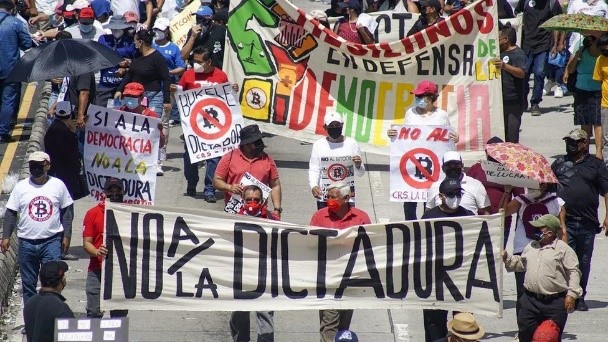
  • Current Realities in El Salvador| Speaker Danielle Mackey | Tuesday, March 8th ~ 7pm

    Register for the (online) event here:  https://www.eventbrite.com/e/228024355987.  There is no cost for these events, but your donations to ICPJ help us to be able to continue this work of educating and mobilizing in our communities. 

    Danielle, a member of The New Yorker‘s editorial staff, based in New York, lived mostly in El Salvador from 2008 until 2021 and was a freelance investigative, longform reporter. Her work has appeared online in The New Yorker, The New Republic and The Atlantic, among others. She still writes and speaks as an independent journalist.

    Her ongoing projects include a series of investigations into narco-activity and corruption in Honduras, with Contracorriente, supported by the Fund for Investigative Journalism, Columbia University’s Center for Mexico and Central America, and the Centro Latinoamericano de Investigación Periodística. Another project involves policing, gangs, and non-carceral and tertiary responses to violence in Central America and in U.S. foreign policy. She has conducted years of reporting on this, funded by grants from various journalism foundations. Danielle has worked as an adjunct professor in the journalism department at CUNY Lehman College and on the research team at The Intercept, among other media posts. Before journalism, she was an NGO-worker and horse trainer. She is an alum of the NYU M.A. in Global Journalism and Latin American Studies.

    This event is hosted by The Interfaith Council for Peace & Justice Latin America Caucus, the University of Michigan Latin American & Caribbean Studies, Wayne State University Center for Latino/a & Latin American Studies, and Huron Valley DSA

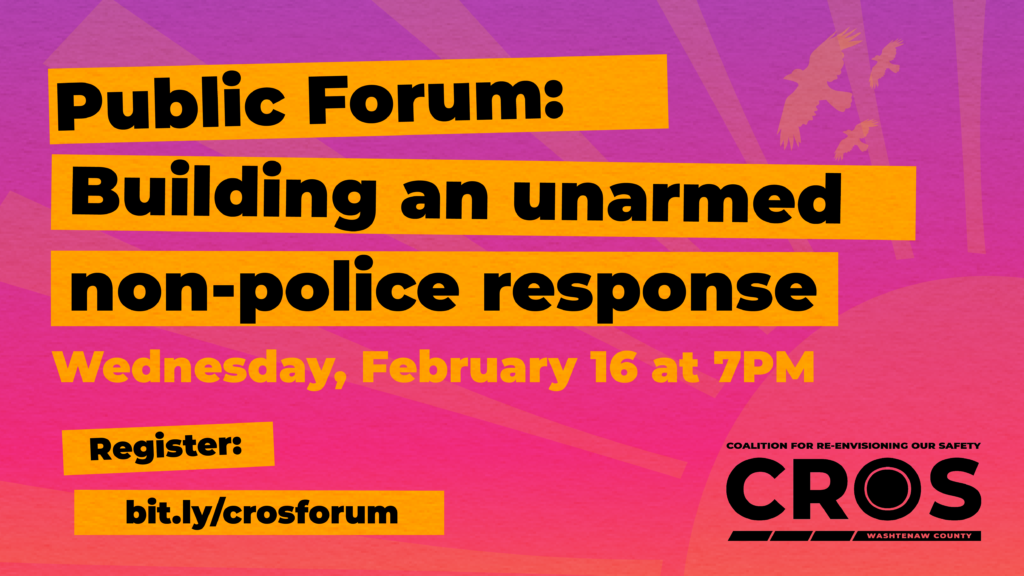
  • Support Community-Led Unarmed Crisis Response

    ICPJ works toward non-violence in our communities, knowing that this can only be achieved through genuine racial and economic equity and justice and by uprooting systems of oppression. Many in our communities have fallen into the misconception that we can only achieve peace through the use of guns and force. But we know that this path has only led to disproportionate violence and imprisonment of Black, Brown, and Indigenous people, and further entrenches us into a cycle of violence. Our vision is for communities in which residents work together to heal the harms of past generations and create community-led responses to crises. Knowing that we have the experience and skills, and the compassion and creativity to solve crises in our community without replicating patterns of violence and harm, ICPJ enthusiastically supports the CROS proposal. We are ready to join with other community partners to create new solutions that move our communities closer toward our vision of justice and nonviolence.

    Here’s what you can do today to get involved in building an unarmed, non-police response in Ann Arbor:

    1. Sign onto the CROS plan and share it with your networks!

    2. Fill out this form for Ann Arbor ARPA funds to go towards unarmed response!
    The City of Ann Arbor would like to know which projects Ann Arborites would recommend to be funded using the $24 million of American Rescue Plan Act (ARPA) funding that the city will receive. Fill out the form and vote for unarmed response today!

    3. Create your personal endorsement graphic!
    Follow this link, then click “edit” to open the image studio on your browser. You’ll be to upload a photo of yourself, and add in a quote about why you support unarmed, non-police response in your community. When you’re done editing, click “export” on the top right to download your image and post it! If you prefer to use Canva, click this link here.

    Creation your personal endorsement video!
    Share a 30 second recorded video of either your statement or how you, your family, neighborhood, workplace, etc. would benefit from a non-police response program. Please send your items to the CROS email by Friday COB, February 11.

    4. Are you part of an organization? Email CROS to endorse the plan!

    5. Email CROS  to volunteer.

    6. Follow CROS on Facebook and Instagram and share our pages!

    Join the Public Forum on February 16th

    Review of the History: The City of Ann Arbor passed a resolution this past April stating that they would develop an Unarmed Public Safety Response Program. CROS formed in response, with the mission to create a program that would truly serve the needs of our community. The CROS plan is the only plan put forward so far (see the detailed CROS memo challenging the narrative put forth by City administration and the Washtenaw County Sheriff Office) and it was made by and for the community based on thorough research from other models across the country as well as in depth conversations with community members and leaders in Washtenaw County. You can find details on the plan, who we are, and links to our social media and petition here. 

    Why Endorse? This coming March, the city is poised to designate money from ARPA funds to a program for community response. We have just a few more weeks to ensure that this program is created outside of police jurisdiction, funded by the city, and run by the community. We are gathering endorsements from individual community members in order to show the city that there is broad public support for CROS’s plan!

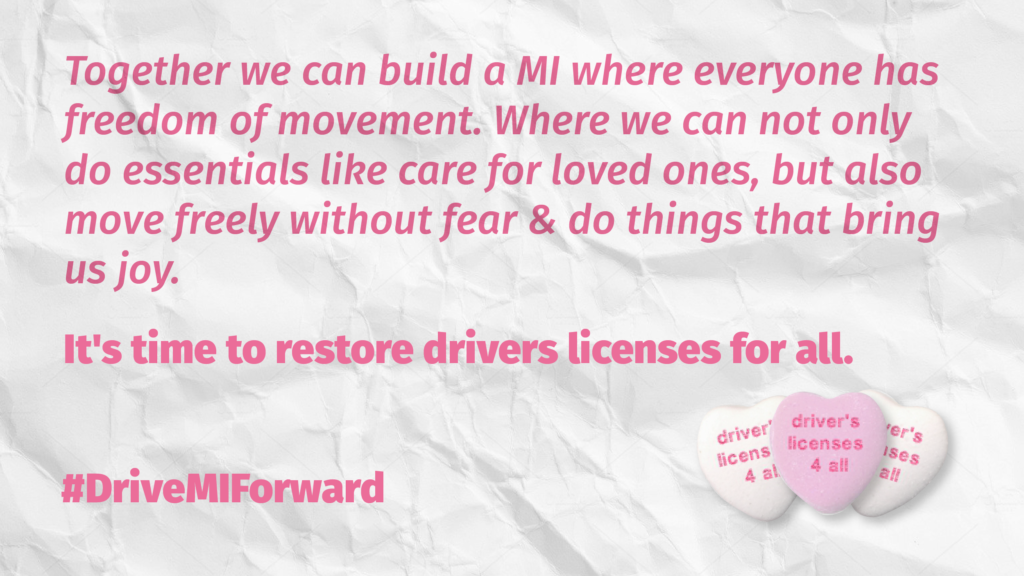
  • #Licenses4LovedOnes

    Monday, February 7th 8am-11am (in person)
    Join ICPJ to send postcards to legislators!
    Meet us at the Daytime Warming Center First Baptist Church of Ann Arbor, 517 East Washington, Ann Arbor

    Monday, February 7th 10am-11am (Online)
    Join ICPJ to send postcards to legislators!
    Register via this link.

    Wednesday, February 9th 7-7:30pm (Online)
    Join ICPJ to call legislators!
    Register via this link.

    Visit our webpage for background information, FAQs, and other resources for this campaign.

    Go to the Take Action Page for more daily actions. Visit Drive Michigan Forward for more information on the Week of Action.